Strontium has four naturally stable isotopes (84Sr, 86Sr, 87Sr and 88Sr), three of which are non-radiogenic: 84Sr (0.560%), 86Sr (9.870%) and 88Sr (82.53%).
The remaining isotope, 87Sr (7.04%), is radiogenic and is formed by the radioactive decay of 87Rb, with a half-life of approximately 4.88 x 10 ^ 10 years.
Based on the principles of strontium isotope geochemistry, it can be shown that 87Sr / 86Sr in human bones and teeth can be used to study aspects of ancient human behavior.
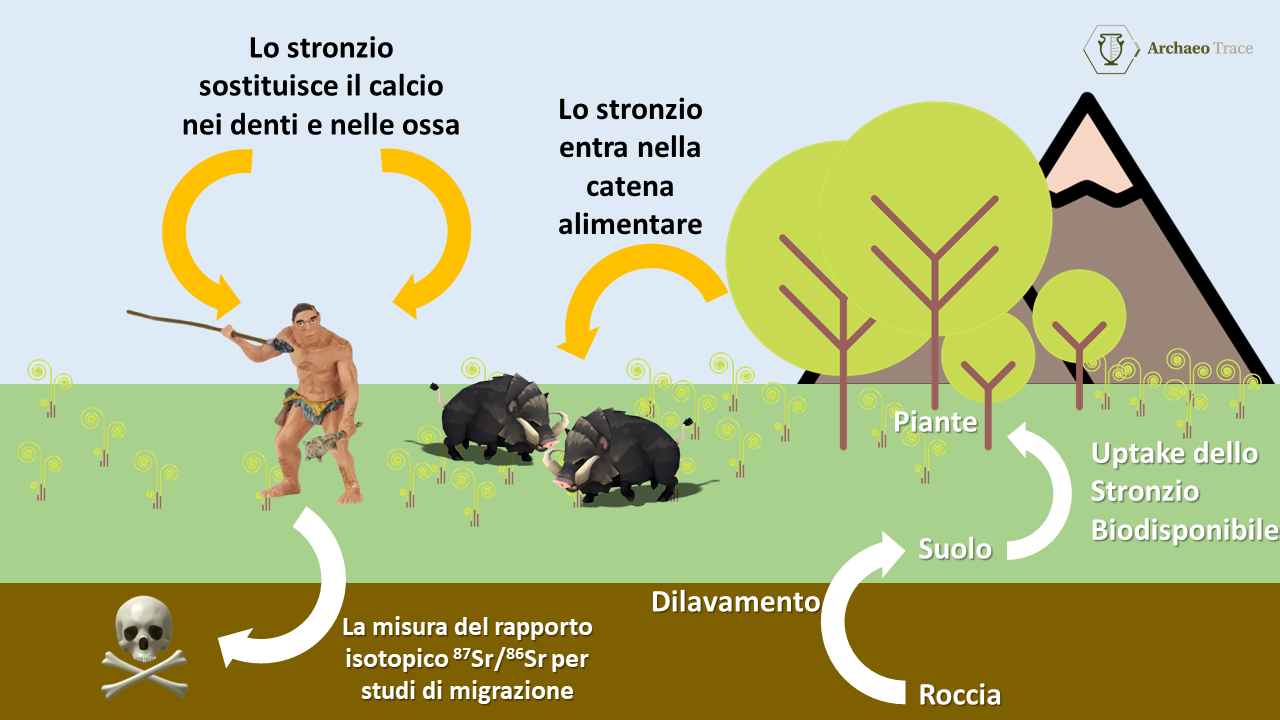
Strontium is ingested with food and having a chemical behavior similar to calcium, it is deposited as a crystal of hydroxyapatite in the enamel of the teeth and in the human bones. The 87Sr / 86Sr ratio reported in human tissue should reflect the 87Sr / 86Sr composition of water, plants and animals consumed, which in turn should reflect the isotopic signatures of the soil in a given region.
Tooth enamel is formed in childhood, after which its chemical composition does not change. On the contrary, human bone continuously remodels itself. Assuming an individual consumed only locally grown foods during their lifetime, the 87Sr / 86Sr values in tooth enamel should reflect infant diet and, by extension, childhood location, while 87Sr / 86Sr signatures in bones will reflect the diet of adults and, ideally, local adult.
Different 87Sr / 86Sr values in the enamel and bone of a single individual may indicate changes in diet over time, which in turn may indicate change of residence.